High Performance Data Facility
Frequently Asked Questions
Project Overview: What is it, exactly?
JLDC
How big is JLDC, and how does that compare to other data center projects?
At about 30,000 square feet, with less than a third reserved for servers, JLDC will be smaller than many commercial hyperscale campuses proposed elsewhere in Virginia. It will be mission-specific to DOE science, not the general consumer cloud.
When will JLDC be ready?
JLDC is expected to be ready for occupation in 2028. The HPDF team is developing concepts for the computer, storage, and networking hardware that will be installed in the building, along with supporting infrastructure. By the time JLDC construction is complete, the HPDF project will be ready for installation and integration over the following two to three years.
Is the building funded?
Yes. The Commonwealth appropriated $49 million for the design and construction of JLDC.
How does the JLDC relate to the DOE Genesis Mission?
JLDC will provide a foundational data hub that supports the Genesis Mission, the national effort to double the productivity of American research with AI. The 2026 funding call underscores sustained federal momentum behind AI-enabled, data-intensive science.
HPDF
What is the difference between HPDF and a commercial data center or the cloud?
A data center is simply any facility that houses computing and storage equipment, and can range from a small server room to massive commercial campuses. JLDC is not the type of hyperscale cloud data centers built for streaming, retail or consumer storage.
Commercial cloud providers, like those in Northern Virginia, are designed for large-scale, power-intensive data processing that supports millions of users. These facilities can require hundreds of megawatts of power, far exceeding the scale of JLDC.
By contrast, JLDC will be a purpose-built facility sized specifically for scientific workloads. The primary mission of HPDF is to help researchers discover, access and analyze scientific data created at DOE labs nationwide, not to store massive amounts of commercial data. Much of the data HPDF works with will be stored at the labs where it is generated. Inside JLDC, HPDF will host tools, services and curated datasets to help scientists connect those distributed resources, not operate a hyperscale cloud environment.
If HPDF accelerates AI development, doesn't the information need to be stored somewhere? Does that make it a data center?
Yes, scientific data must be stored somewhere. In almost all cases, that data is already stored at DOE's national laboratories, many of which maintain their own scientific archives. The challenge today is that each lab stores data independently, often in different formats and systems.
HPDF will provide the platform that lets scientists find, connect, and use that distributed data. It will translate formats when needed, help scientists discover related datasets and provide tools to move data to the right computing resources for analysis. HPDF may temporarily store intermediate results or frequently requested outputs so researchers can retrieve them quickly, but it will not be a central repository for all scientific data.
In that sense, yes, JLDC is technically a data center. And although it will house computing and storage equipment, it will be a small, mission-specific research facility, not a large-scale commercial cloud hub. It will enable scientific discovery, not operate as a public cloud warehouse.
Operations & Infrastructure: The facility's day-to-day function
JLDC
What is the electric usage per month?
For JLDC during its initial, empty-building phase, electricity use is expected to be quite low – on the order of a typical home, roughly under 900 kilowatt-hours per month. Once HPDF equipment is installed, power needs will increase, but the final usage will depend on the specific systems selected during the design phase. Those equipment decisions are not yet final, so the building's projected monthly electrical load is still being developed.
How much strain is this putting on the grid?
Jefferson Lab works directly with Dominion Energy to ensure reliable electrical service and minimize grid impacts. During periods of extreme heat or cold when the regional grid is under stress, the lab partners with Dominion to voluntarily reduce its power demand, helping ensure that essential customers like hospitals, care facilities and local residents maintain stable service. This coordinated approach will ensure JLDC and future HPDF operations do not contribute to local grid strain.
How are the servers cooled?
We anticipate using water-cooled chips, which are becoming standard for high-performance computing. We are also monitoring emerging options, including direct-refrigerant chip cooling, as the technology evolves.
Will the facility have diesel generators?
No generators are planned at this time for JLDC.
Environmental Impact: Water use and stewardship of resources
JLDC
Is this an open-loop or closed-loop system?
The JLDC building itself will use air-to-air cooling and will not require a water-based loop. For HPDF operations, the cooling design is still in development. However, based on Jefferson Lab's LEED Gold commitment and environmental requirements, we expect to use closed-loop cooling systems where appropriate.
How will chemical buildup in a closed-loop system be managed?
Any closed-loop cooling system used for HPDF would include automated water treatment and monitoring to maintain safe chemical levels. When needed, the system would be safely drained, refreshed and treated in accordance with environmental standards.
What type of water will be used?
No new wells or groundwater extraction are planned. The project will use a municipal supply provided by Newport News Waterworks.
How much water runoff is expected?
Stormwater will be managed on-site using a rain garden and an underground retention tank, which will slow and filter runoff to prevent flooding and minimize environmental impact.
Community Impact: Effects on neighboring communities
JLDC
What precautions are being taken to mitigate noise for nearby homes and businesses?
JLDC will be a small, low-noise scientific facility. The sound level inside will be comparable to a typical office server room. The building will be constructed with sound-dampening materials, and surrounding street noise on Jefferson Avenue will be louder than anything produced by the facility.
Economic Impact: Funding, jobs and return on investment
HPDF
What is the $300 million funding being used for if the project will create only 100-200 jobs?
The funding covers the full build-out of a national research capability, not just staffing.
Here is how the investment breaks down:
- Facility build-out (~$50M): Transforming the empty JLDC building into a fully functional scientific data facility including power distribution, cooling systems, wiring, raised flooring and other essential infrastructure needed for advanced computing.
- Computing, storage, networking and software (~$150M): Purchasing and installing the high-performance systems that will power HPDF. These systems will be installed primarily by specialized contractors.
- Five-year project development, integration and management (~$100M): Design work, project management, software development, and the integration of complex data and computing systems across two national laboratories. Because HPDF must operate as a resilient, dual-site national capability, the investment supports infrastructure, technology and multi-lab collaboration. While HPDF will eventually support roughly 100-200 staff, the broader impact includes long-term scientific collaboration, innovation and economic activity in Virginia and across the national research enterprise.
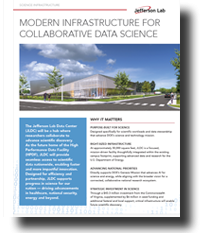
Animated rendering of the future Jefferson Lab Data Center