
NEWPORT NEWS, VA – The U.S. Department of Energy’s Thomas Jefferson National Accelerator Facility marked the ceremonial start of construction for the Jefferson Lab Data Center (JLDC), a new building situated on the national laboratory’s Newport News campus that will serve as the future home of DOE’s High Performance Data Facility (HPDF).
Darío Gil, the DOE’s Under Secretary for Science, joined other distinguished guests at the groundbreaking event following a tour of the lab’s accelerator and research facilities, where he met with researchers and engaged with staff and scientific users.
“AI, advanced computing, and the experimental facilities and instruments of our National Laboratories are converging to change how discovery happens,” Gil said. “This High Performance Data Facility is where that convergence takes physical form: the place where our data, instruments, and computing meet and become usable to researchers nationwide. Breaking ground on it marks a major step forward for the Genesis Mission.” (More)
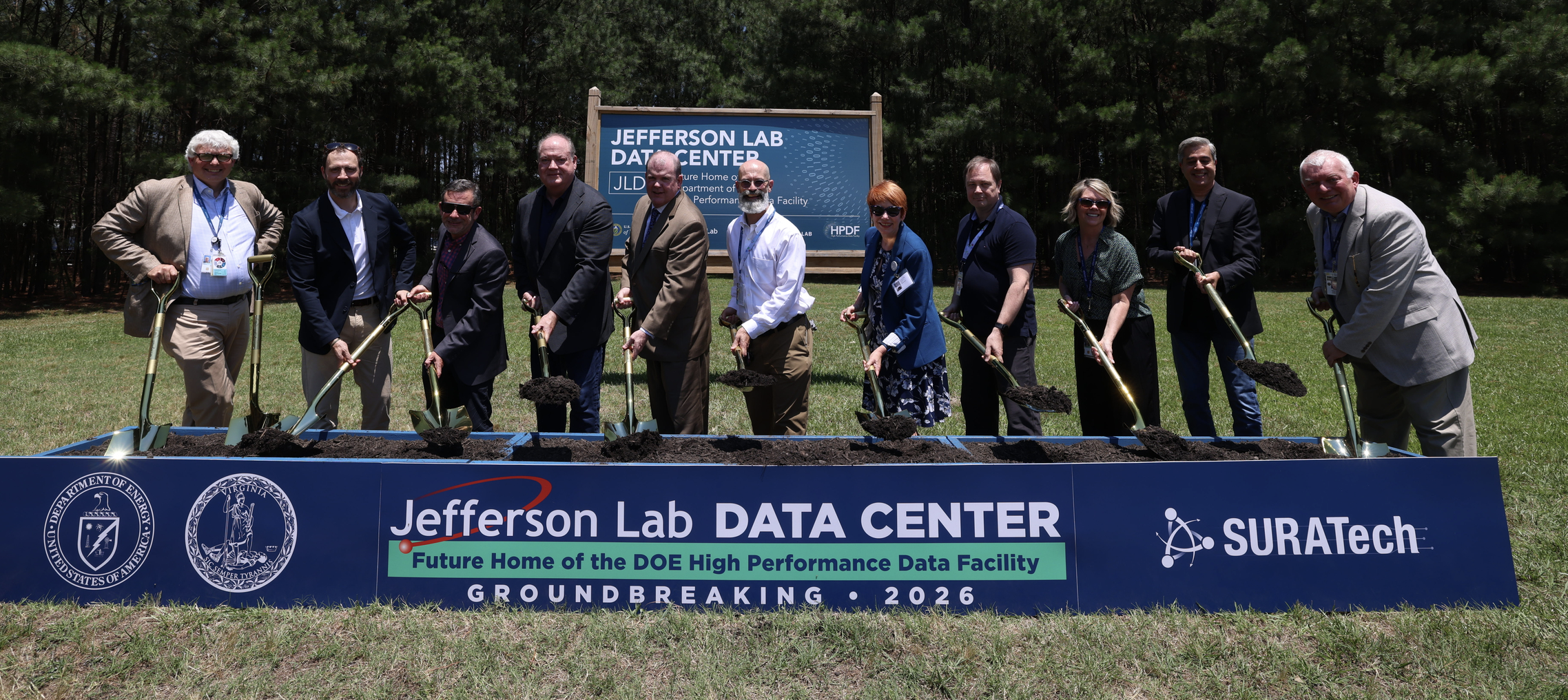
Members of the HPDF Project team, along with other lab colleagues, at the June 12, 2026, groundbreaking for the future home of the High Performance Data Facility.
EJFAT prototype demonstrates proof of concept for connecting scientific instruments with remote high-performance computing for rapid data processing
NEWPORT NEWS, VA – In April 2024, scientists at Thomas Jefferson National Accelerator Facility (Jefferson Lab) clicked a button and held their collective breaths. Moments later, they exulted as a monitor showed steady saturation of their new 100 gigabit-per-second connection with raw data from a nuclear physics experiment. Across the country, their collaborators at Energy Sciences Network (ESnet) were also cheering: the data torrent was streaming flawlessly in real time from 3,000 miles away, across the ESnet6 network backbone, and into the National Energy Research Scientific Computing Center's (NERSC's) Perlmutter supercomputer at Lawrence Berkeley National Laboratory (Berkeley Lab).
Once it reached NERSC, 40 Perlmutter nodes (more than 10,000 cores) massively processed the data stream and sent the results back to Jefferson Lab in real time for validation, persistence, and final physics analysis. This was achieved without the need for any buffering or temporal storage and without experiencing data loss or latency-related problems. (In this context, “real time” means streamed continuously while processing is performed, with no significant delays or storage bottlenecks.)
This was only a test — but not just any test. “This was a major breakthrough for the transmission and processing of scientific data,” said Graham Heyes, Technical Director of the High Performance Data Facility (HPDF). “Capturing this data and processing it in real time is challenging enough, doing it when the data source and destination are separated by distances on continental scales is very difficult. This proof-of-concept test shows that it can be done and will be a game changer.” More
NEWPORT NEWS, VA – Old Dominion University and the U.S. Department of Energy's Thomas Jefferson National Accelerator Facility share a bond that goes back nearly 40 years, to the lab’s founding in 1984. Now, they’re taking their partnership to a new level.
The fellow research institutions are launching a unique joint institute that will leverage Jefferson Lab’s specialties in data science and computing in an effort to tackle the most pressing problems and disparities at the intersection of health and the environment in Hampton Roads.
Weeks before the launch of ACES, the DOE announced Jefferson Lab would become the home of a new computational resource – the High Performance Data Facility. The $300+ million project is still years from fruition, but the joint institute’s team is already thinking of ways to incorporate the new user facility’s potential into their plans. (More)
Accelerator facilities that allow nuclear physicists to probe the inner workings of atoms and their nuclei require a costly high-wire act of data acquisition and storage. Take, for example, the Continuous Electron Beam Accelerator Facility (CEBAF) at the Department of Energy’s Thomas Jefferson National Accelerator Facility, or JLab, in Newport News, Virginia. At CEBAF, electrons hurtle at close to lightspeed into a target, obliterating protons and neutrons.
Every piece of atomic debris is diligently tracked by a suite of detectors, generating tens of gigabytes of data per second. Until recently, capturing this data for post-experiment analysis required priming servers to receive data at irregular intervals and keeping the whole system calibrated for experiments that can last for hours, weeks or years.
“It’s been done this way for time immemorial,” says Graham Heyes, JLab’s scientific computing head.
Now, JLab has found a new way to do it: streaming the mountain of data pouring out of detectors directly into powerful computer systems to allow real-time filtering, calibration and analysis, all of which will save the lab time and money. (More)
NEWPORT NEWS, VA – Today, the U.S. Department of Energy (DOE) announced the selection of the High Performance Data Facility (HPDF) hub, which will create a new scientific user facility specializing in advanced infrastructure for data-intensive science. The Thomas Jefferson National Accelerator Facility (JLab) will be the HPDF Hub Director, and the lead infrastructure will be located at JLab. The project to build the Hub will be a partnership between JLab and Lawrence Berkeley National Laboratory (LBNL), and the two labs will form a joint project team led by JLab charged to create an integrated HPDF Hub design.
The High Performance Data Facility is envisioned as a national resource that will serve as the foundation for advancing DOE’s ambitious Integrated Research Infrastructure (IRI) program. The IRI aims to provide researchers the ability to seamlessly meld DOE’s unique data resources, experimental user facilities, and advanced computing resources to accelerate the pace of discovery. The mission of the HPDF will be to enable and accelerate scientific discovery by delivering state-of-the-art data management infrastructure, capabilities, and tools. HPDF will provide leadership in the stewardship of the scientific data lifecycle and will advance DOE’s and the Biden Administration’s commitment to public access to scientific data and FAIR data principles (Findable, Accessible, Interoperable, and Reusable). The competition to lead the High Performance Data Facility was open to the Office of Science national laboratories. (More)
A recent pair of proof-of-concept tests laid groundwork that will inform design and implementation decisions for the newly approved HPDF Hub. The demonstrations, with the SLAC National Accelerator Laboratory and the Globus research data management service at Argonne National Laboratory, tested the transfer of scientific data from producers to processors, such as the HPDF-H.
A smooth transition will benefit researchers who need seamless and rapid remote processing for experiments that generate massive amounts of data. The tests ensured that real cases for scientific data processing could work at multiple data centers, resolving conflicts that might arise as data moves from one setting to another. It was an opportunity to work out details, such as how to move files, balance heavy CPU loads, and organize workflows. The results will also allow designers to detect potential bottlenecks.
The SLAC demonstration used a specific existing workflow, customized to run at Jefferson Lab. Globus, on the other hand, showed how its established platform and mature suite of services could be used to fold JLab into an existing data processing ecosystem. The SLAC test involved more development and a close look at details, while Globus focused on rapid deployment. Case studies like these give designers valuable operational experience and feedback that will inform HPDF-H plans for scalability, reliability, and robustness.
WASHINGTON, D.C. - Today, the U.S. Department of Energy (DOE) announced $16 million in funding for nine projects focused on advancing innovative fusion technology and collaborative research on small-scale experiments and on the DIII-D National Fusion Facility, an Office of Science scientific user facility. The projects will be executed under 16 awards at 13 institutions across the nation.
Technology projects will develop new systems on DIII-D, a facility operated by General Atomics in San Diego, CA, and at collaborating institutions with plans to install the systems on DIII-D once prototypes have been demonstrated and characterized. Collaborative research aims at using existing world-leading capabilities of the DIII-D facility to establish the scientific foundation needed to develop a fusion energy source. A key objective is to enable the U.S. to aim at a fusion pilot plant based on the tokamak concept.
The projects will assess and improve the technical maturity of plasma actuators; provide tools and algorithms, including artificial intelligence and machine learning, that can sustain high fusion performance and avoid disruptive plasma instabilities; resolve key plasma transport issues in regimes relevant for fusion power plants; improve access to burning plasma regimes; and optimize the fusion reaction process itself in order to relax the field and confinement requirements for a fusion pilot plant. (More)
WASHINGTON, D.C. — The U.S. Department of Energy (DOE) announced $37 million in funding for 52 projects to 44 institutions to build research capacity, infrastructure, and expertise at institutions historically underrepresented in DOE’s Office of Science portfolio, including Minority Serving Institutions (MSIs) and Emerging Research Institutions (ERIs). Through the Funding for Accelerated, Inclusive Research (FAIR) initiative, the Office of Science is supporting mutually beneficial relationships between MSIs/ERIs and partnering institutions to perform basic research in applied mathematics, biology, chemistry, computer science, engineering, geoscience, isotope research, materials science, and physics. Ensuring America’s best and brightest students have pathways to STEM fields will be key to achieving President Biden’s energy and climate goals, including achieving a net-zero carbon economy by 2050.
“FAIR is an essential capacity-building initiative that will broaden the impact of DOE and the Office of Science in tackling critical and pressing scientific questions and challenges,” said U.S. Secretary of Energy Jennifer M Granholm. “To reach our scientific goals, we need all voices represented at the table, including those who have been historically excluded from critical scientific conversations. This funding will help academic institutions expand their research portfolios and spur future scientific discovery, creating a top-notch workforce to advance American competitiveness.”
Of the 44 awardee institutions, 43 are ERIs and 25 are identified by the U.S. Department of Education as MSIs, including eight Hispanic-Serving Institutions (HSIs), six Historically Black Colleges and Universities, two Asian American and Pacific Islander Serving Institutions (AANAPISIs), one Tribal College and University, and eight that are both HSIs and AANAPISIs. (More)
In January 2023, the White House Office of Science and Technology Policy (OSTP) launched the Year of Open Science, featuring actions across the federal government to advance national open science policy, provide access to the results of the nation's taxpayer-supported research, accelerate discovery and innovation, promote public trust, and drive more equitable outcomes.
The Department of Energy, represented by the Office of Scientific and Technical Information (OSTI), has joined other federal agencies to promote and contribute to the Year of Open Science. Throughout 2023, federal agencies are collaborating to inspire open science engagement through events and activities that will advance adoption of open, equitable, and secure science.
DOE OSTI, in conjunction with its role as the host of the Science.gov site, also hosts and maintains the Year of Open Science website - Open.Science.Gov. Participating agencies, including DOE, provide routine updates on their Open Science initiatives and activities. DOE's contributions have featured PIDs@OSTI.GOV (DOE's persistent identifier services), the Public Reusable Research (PuRe) Data Resources, and DOE CODE (the DOE software services platform and search tool).